Background
The EU Anti-Corruption Initiative in Ukraine (EUACI) is the European Union’s technical support program in the area of anti-corruption in Ukraine, co-funded and implemented by the Ministry of Foreign Affairs in Denmark. The overall objective of the EUACI is to achieve significant progress in preventing and countering corruption, ensuring the coherence and systemic anti-corruption activities of state and local self-government bodies, and to empower civil society and citizens to contribute to the combatting of corruption, as well as the proper process of Ukraine’s post-war recovery. The program runs till April 2027.
One of the partners of the EUACI is the Specialised Anti-Corruption Prosecutor’s Office (SAPO). According to provisions of Ukrainian legislation, SAPO is responsible for exercising oversight of compliance with the law during operative and investigative activities and pre-trial investigations carried out by the NABU; supporting public prosecution in relevant proceedings; and the representation of the interests of a citizen or the state in cases provided for by law and related to corruption or corruption-related offences.
SAPO’s Institutional Strategy 2026-2028, approved on 12 December 2025, establishes, under Goal 3, the development of a model for measuring prosecutorial workload. This model is intended to determine the level and distribution of workload among prosecutors, improve workload management, and enable the future introduction of an automated allocation system for criminal proceedings, taking into account objective workload indicators. At present, SAPO does not possess a unified, standardised, or methodologically robust framework for assessing prosecutorial workload.
In this context, the EUACI intends to engage a qualified Service Provider to develop a Methodology for Assessing Prosecutorial Workload, which will serve as a foundational tool for the implementation of Goal 3 of SAPO’s Institutional Strategy. In particular, there is a need to establish clearly defined and classified categories of prosecutorial activities, objective indicators for measuring workload, analytical and/or mathematical models for aggregating workload into measurable units, and an evidence-based basis for equitable distribution of cases.
Objective
Overall objective: to support SAPO in fulfilling the strategic Goal 3 set out in its Institutional Strategy, in particular by strengthening its capacity to manage prosecutorial resources in an efficient, transparent, and accountable manner.
Sub-objective: to engage a qualified consultant (company or group of experts) to develop a substantiated and transparent methodology for assessing the workload of prosecutors, which takes into account all key types of prosecutorial activities, is based on empirical data and analytical approaches, and can subsequently be used as the basis for automated allocation of proceedings. Scope of work
The Service Provider shall develop a comprehensive, evidence-based, transparent, and reproducible methodology for assessing the workload of SAPO prosecutors, including but not limited to:
- Comprehensive assessment of the current state of prosecutorial workload management within SAPO. This shall include a review of all relevant regulatory, methodological, and internal documents, as well as available statistical and operational data. The purpose of this stage is to identify existing practices, gaps, and constraints in the current approach to workload distribution, as well as to determine which elements may be retained or adapted in the proposed methodology.
- Functional analysis of prosecutorial activities resulted in a structured and comprehensive classification of the types of activities performed by SAPO prosecutors, covering, inter alia, procedural supervision of pre-trial investigations, representation in court proceedings, participation in civil confiscation processes, handling of requests and complaints, as well as involvement in coordination, training, and public engagement activities. For each category of activity, the Consultant shall identify typical tasks and operations, define measurable units of work, and determine the key factors influencing the complexity and intensity of such activities.
- Analysis of the accessible data (including that recommended by SAPO) on the workload assessment systems in the EU Members States, or other countries if proved relevant, and assess which particularities, considerations or solutions should be taken into account in a to-be-developed SAPO model.
- Analysis of data extracted from relevant information systems (IS) used by SAPO (including, where applicable, Unified Register of Pretrial Investigation (URPI), Accounting and Statistics of the Prosecutor’s Office (OSOP), and eCase, with a view to assessing the number, duration, and complexity of proceedings, as well as the actual distribution of workload among prosecutors. The development of the methodology shall be based on a combination of qualitative and quantitative research approaches.
- Development of a workload assessment model capable of aggregating different types of prosecutorial activities, their complexity and frequency, into a single, integrated workload indicator. The model shall take into account both quantitative parameters (including the number of proceedings) and qualitative factors (including case complexity and additional non-procedural responsibilities), and shall be based on transparent and replicable calculation principles.
- Preparation of a document Methodology for Assessing Prosecutorial Workload, which shall present the methodology, key findings, and practical recommendations in a clear, structured, and implementation-oriented manner, including recommendations for the potential modernisation of SAPO’s information systems to support workload assessment and, in the longer term, automated case allocation.
Deliverables
The Service Provider shall deliver the following outputs:
| # | Deliverable/Output | Timeline | Note |
| 1 | Workplan | One week after signing the contract | To be submitted to the EUACI and SAPO by email ahead of the Kick-Off meeting in English |
| 2 | Methodology for Assessing Prosecutorial Workload | 3 months after signing the contract | Based on the results of the assignment, the Consultant shall prepare a document titled “Methodology for Assessing the Workload of Prosecutors”, which shall include: description of the proposed approachclassification of types of prosecutorial activitiesworkload assessment modeldefined formulas and workload indicatorsrecommendations for the application of the methodology, including its use for the automated case allocation and integration with the existing SAPO IS |
| 3 | Presentation of the results | 3 months after signing the contract | The Consultant shall prepare and deliver a presentation (PowerPoint) of the methodology and recommendations for SAPO and the EUACI |
All documentation shall be prepared in paper and electronic forms. Language of the Outputs is Ukrainian with English translation of the Executive Summary of the Methodology and of the Presentation.
Qualifications
It is envisaged that the assignment will be implemented by a team of experts familiar with the context and experienced with similar assignments.
The Contractor’s team is expected to comprise the following profiles:
- Project Manager / Digital Transformation Expert
- Senior Business Analyst / Prosecution Domain Expert
- Data Analyst / Statistical Modeling Expert
The project team should be delegated for the entire duration of the project. The composition of the project team may only be modified as a matter of exception, subject to agreement of the parties. The contractor should provide a qualified replacement in a short time.
Key qualifications of the Consultant’s team include:
General qualifications:
- Bachelor’s or Master’s degree in Computer Science, Information Technology, or a related field.
- Relevant certifications in IT security, systems integration, or project management are an advantage.
- Experience delivering analytical and consulting projects in IT, digital transformation, or the public sector.
- Experience applying mixed research methods (quantitative and qualitative), including data analysis, interviews, focus groups, and surveys.
- Experience preparing analytical reports, methodologies, concepts, or recommendations for implementing IT solutions or organizational changes.
Adequacy for the assignment:
- Experience in automation of prosecutorial activities, including supervision of pre-trial investigations, courtroom representation, as well as related procedural and administrative functions, with deep understanding of real workload factors in prosecutorial practice.
- Expertise in business process modelling and optimization, enabling the development of a well‑structured model of prosecutors’ activities.
- Experience in collecting, structuring, and formalizing requirements to ensure correct decomposition of activities and workload factors.
- Ability to conduct in-depth qualitative research (interviews, focus groups) to identify real work practices and hidden workload drivers.
- Experience working with large datasets and statistical analysis to develop a quantitatively grounded workload model.
- Competence in designing evaluation models (including coefficients, weights, and indicators) to ensure formalization of the methodology.
- Deep understanding of the prosecution domain and processes, ensuring practical relevance of results.
- Ability to integrate analytical findings into practical recommendations for further automation (including automated case allocation systems).
- Experience working with international technical assistance projects will be an advantage.
Experience with the region and languages:
- Professional experience in Ukraine or in countries with comparable legal and institutional frameworks.
- Physical presence in Kyiv
- Fluency in Ukrainian and good English proficiency.
Budget, timeframe, and location
The maximum budget for the assignment is up to EUR 8,000. The activity is expected to be conducted within 3 months. The duration of the contract is to begin following the signature of both parties. The project activities are performed in Kyiv, Ukraine.
All the payments under the Service Provider shall be made in UAH according to the official NBU exchange rate published on the business day of the invoice issuance by the Service Provider. The Service Provider may request 30% of the payment on signing the contract and the remaining 70% will be paid when the entire assignment will be completed. The final payment will require verification of completion of deliverables and approval by the EUACI and SAPO of the Service Provider’s deliverables.
Reporting and management
The performance of the Service Provider will be judged upon reaching the purpose of this contract as well as obtaining its results, as indicated in the section “Objective” and “Deliverables” herein respectively. Moreover, the performance of the Contractor will be judged upon the successful implementation of all the specific activities indicated in Section “Scope of work” of this document
The EUACI will appoint an expert responsible for the management of this assignment from the side of the EUACI, including for any correspondence with regard to the implementation of the assignment and for issues related to the agreement between the Service Provider and the EUACI. The Service Provider will report to and ensure that the appointed expert is copied in on all relevant communication related to the assignment, including correspondence with all stakeholders.
In the period until acceptance, the EUACI together with SAPO and Service Provider will hold regular project group meetings to exchange information and seek to clarify any questions of whatsoever nature. The purpose of the project group meetings is to ensure follow-up on any activities between the meetings, and to maintain a common overview of the current stage of the project at a detailed level, and to ensure the day-to-day progress.
Confidentiality
By signing the contract, the Service Provider agrees to hold in trust and confidence any information or documents (“confidential information”) disclosed to the Service Provider or discovered by the Service Provider or prepared by the Service Provider in the course of or as a result of the implementation of the contract, and agrees that it shall be used only for the contract implementation and shall not be disclosed to any third party. The Service Provider also agrees not to retain copies of any written information in its archive and for its use.
How to apply
The deadline for submitting the proposals is 6 MAY 2026, 10:00 Kyiv time.
All interested expert(s) or companies should submit:
- Filled and signed Appendix 1 (portfolio of previous studies, assessments or projects demonstrating the ability to develop methodology, CV of expert(s), short description of approach and methodology of the proposed consultancy)
- Signed Financial offer (budget for the consultancy service in EUR, inclusive of all taxes or other such charges without VAT).
The Service Provider’s financial proposal shall include all costs for a fee and project-related reimbursable expenses.
The proposal shall include the aforementioned information and should be submitted within the above deadline to [email protected], CC [email protected] indicating the subject line: Development of a Methodology for Assessing Prosecutorial Workload of SAPO prosecutors
To ensure your documents were successfully received, please check that you have received an auto-reply from [email protected] mailbox.
Bidding language: English.
Questions & Answers:
Any clarification questions regarding the bid request may be submitted in English via e-mail to the contact person mentioned above. Tenderers shall refrain from contacting the EUACI in any other way.
Tenderers are encouraged to submit all questions as soon as possible. The EUACI reserves the right to not answer questions submitted later than 5 days before the time limit for receipt of tenders.
The EUACI will send the questions and answers simultaneously and in anonymous form via
e-mail to the tenderers.
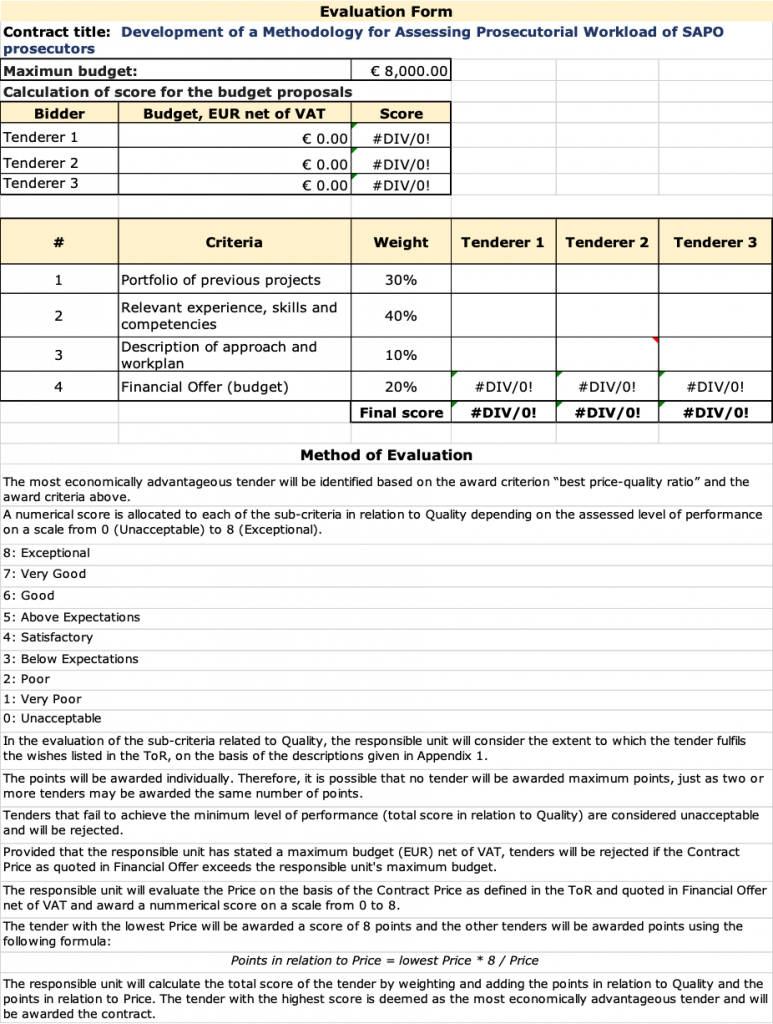
Evaluation
Bids will be evaluated in accordance with the criteria provided below:
| # | Criteria | Weight |
| 1 | Portfolio of projects | 30% |
| 2 | Relevant experience, skills and competencies | 40% |
| 3 | Description of approach and methodology of the proposed consultancy | 10% |
| 4 | Financial Offer | 20% |
The evaluation methodology is described in Appendix 2.
Appendix 1: Forms for Letter of Tender
The tenderer must fill in fields marked with yellow and sign this Appendix 1 before submission.
The request to participate is submitted by the following:
| Name | [insert name of company or full name and surname of private entrepreneur] |
| Street and number | [insert postal address] |
| Postcode | [insert postal code] |
| City | [insert city] |
| Country | [insert country] |
| VAT number (or national identification number) | [insert number] |
| Internet address | [insert URL of the company’s website (if available)] |
| Contact person | [insert name of contact person] |
| [insert e-mail of contact person] |
List of previous studies, assessments or projects:
The applicant has performed (entered into, ongoing or finalised within the last 5 years) the following contracts of relevance to the advertised assignment (at least 3 contracts).
| No. | Description | Amount | Contract period | Recipient |
| 1. | [insert nature and quantity of services provided by the tenderer (and, if joint venture, by which member). If the performed services are provided in a joint venture or within a framework agreement with more economic operators, insert the quantity (percent) performed by the tenderer] | [insert contract value] | [insert start date and end date] | [insert name of organisation] |
| 2. | [insert nature and quantity of services provided by the tenderer (and, if joint venture, by which member)] | [insert contract value] | [insert start date and end date] | [insert name of organisation] |
| 3. | [insert nature and quantity of services provided by the tenderer (and, if joint venture, by which member)] | [insert contract value] | [insert start date and end date] | [insert name of organisation] |
The Tenderer’s methodology and approach
This section comprises templates to be completed by the tenderer and included in the tender.
The tenderer’s submissions will be included in the Contract and apply to the project.
Approach and methodology regarding the development of a methodology for assessing prosecutorial workload of SAPO prosecutors
The completed sections regarding methodology of the study should not exceed 3 pages
[The tenderer shall as part of the tender and in accordance with the requirements describe his approach and methodology in order to develop and implement the requirements to the assignment.
The Tenderer’s Approach and Methodology will be part of the evaluation in regard to the “Criteria and Method of Evaluation”. Thus, the EUACI will evaluate the following:
(i) Whether the proposed approach and methodology reflects the objectives of the project
(ii) Whether activities of the project are coherent and well-defined
(iii) Whether the tenderer has identified risk and highlighted potential issues
(iv) The extent to which the tender fulfils the requirements
Curriculum Vitae for Expert(s)
General Qualifications, Adequacy for the assignment and Experience in the Region and Language
The tenderer is to complete and submit a CV for each of its key staff based on the format below (apply if more than one exert).
Each completed CV should not exceed 3 pages.
| Assignment: | |||||||
| Proposed position on the proposed team: | |||||||
| 1. PERSONAL DATA | |||||||
| Family name: | First Name(s): | ||||||
| 2. EMPLOYMENT RECORD (GENERAL EXPERIENCE) (Most recent employment first) | |||||||
| Employer’s company name: | Period of service and length: | Position / nature of the tasks performed / level of responsibility: | |||||
| 3. EDUCATION AND TRAINING (Most recent completed education and or training first) | |||||||
| Institution (University, etc.), city and country: | Length of education Date: from (month/year) to (month/year) | Degree/Diploma obtained: | |||||
| 4. EXPERIENCE IN THE SPECIFIC FIELD DIRECTLY RELEVANT TO THE ASSIGNMENT AND THE PROPOSED POSITION (Indicate the following information for those assignments that best illustrate the experience in the specific field relevant to the assignment and the proposed position, including the obtained results) (Add number of assignments as applicable) | |||||||
| Name of assignment | |||||||
| Period of service and length: from (month/year) to (month/year) | |||||||
| Location | |||||||
| Client | |||||||
| Main project features | |||||||
| Position held | |||||||
| Activities performed | |||||||
| Obtained results | |||||||
| 5. LANGUAGE SKILLS OF RELEVANCE TO THE ASSIGNMENT (State knowledge of the language in the country of assignment and of the contract) | |||||||
| Language: | Formal Education: | Understanding level: | Speaking level: | Writing level: | |||
| 6. OTHER INFORMATION OF RELEVANS TO THE ASSIGNMENT | |||||||
Appendix 2: Method of Evaluation